Astrology compatibility score is a simple way to describe how well two people may match based on their zodiac signs, birth charts, and key astrological placements. Many people look for a quick number, such as 70% or 85%, because they want a fast answer about love, attraction, and long-term potential. That is understandable. Dating can be confusing, mixed signals are common, and people often want one clear sign that they are moving in the right direction.
The useful part is this: a compatibility score can be a starting point for reflection. The risky part is this: it is not a final answer about whether a relationship will work. A high score does not guarantee trust, respect, or emotional safety. A low score does not mean two people are doomed.
What an astrology compatibility score usually means
In most astrology tools, a compatibility score is a simplified result based on how two charts interact. Some calculators use only sun signs. More detailed versions compare the full birth charts of both people.
A basic score may look at:
- Sun sign compatibility for overall style and identity
- Moon sign compatibility for emotions and comfort
- Venus compatibility for love language, affection, and attraction
- Mars compatibility for passion, desire, and conflict style
- Mercury compatibility for communication
- Aspects such as trines, squares, oppositions, and conjunctions
- House overlays that show which parts of life one person activates in the other
That is why one website may show 92% while another shows 61%. They are not always measuring the same things.
Why people care about compatibility scores
People usually do not search this topic out of pure curiosity. They search because they are facing a real problem. They like someone but feel unsure. They are in a relationship with strong chemistry but frequent arguments. They keep meeting people who feel exciting at first and draining later. A quick astrology score feels like a way to reduce uncertainty.
This interest is very common. Many people check zodiac compatibility before a first date, during a new romance, or after a breakup when they are trying to understand what went wrong. In practice, astrology compatibility is often used not only for romance, but also for emotional reassurance.
How compatibility scores are usually calculated
Most systems follow a scoring model. The exact formula changes, but the logic is often similar.
- Base sign match — compares the two sun signs
- Emotional match — checks moon signs and emotional style
- Romantic match — reviews Venus and Mars placements
- Mental match — looks at Mercury and communication patterns
- Tension factors — counts difficult aspects that may create friction
- Balance factors — adds supportive aspects that help stability
Some calculators then convert all of that into a number from 0 to 100. Others use labels such as excellent match, challenging match, or soulmate potential.
What different score ranges often suggest
A score becomes more useful when you understand what it is trying to say.
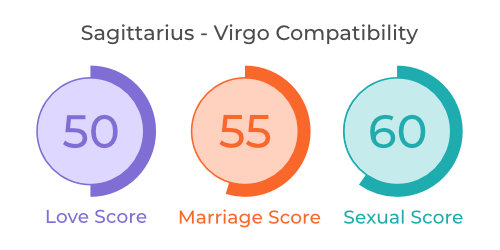
- 80–100 — strong natural flow, easier emotional or romantic alignment, fewer obvious friction points
- 60–79 — good potential, but some areas need effort, especially communication or expectations
- 40–59 — mixed match, attraction may exist but habits and emotional needs may clash
- 0–39 — more tension in the chart comparison, stronger need for patience, maturity, and honest discussion
These ranges are not rules. They are closer to a map than a verdict.
Why sun sign matching alone is not enough
Many people make one common mistake: they judge the whole relationship by sun sign compatibility alone. That is too limited. Two people can have sun signs that look ideal on paper and still struggle with emotional distance, jealousy, poor timing, or constant misunderstandings. At the same time, two people with a lower sign match can build a healthy bond if they communicate well and respect each other.
That is why professional astrologers usually look beyond the sun sign. In relationship questions, moon, Venus, Mars, and Mercury often tell a more practical story.
The placements that matter most in relationship astrology
If you want a more useful reading, pay attention to these areas:
Moon
This shows emotional needs. One person may need reassurance and closeness, while the other needs space and calm. If moon signs clash, people can feel unloved even when love is present.
Venus
This shows how a person gives and receives affection. One partner may want verbal warmth, gifts, and romance. Another may show love through reliability and actions.
Mars
This shows desire, drive, and conflict response. It often explains why attraction is strong but arguments escalate fast.
Mercury
This shows communication style. Many relationships do not fail because love is missing. They fail because people explain badly, assume too much, or shut down during conflict.
Saturn
This can bring commitment, structure, and lessons. It can also feel heavy if the relationship becomes too strict or emotionally hard.
What astrology can do well and where it has limits
Astrology compatibility can be useful for spotting patterns. It can help people think about emotional needs, recurring conflict themes, attraction style, and relationship habits. That can open good conversations.
But astrology does not scientifically prove who will be a good partner. A compatibility score can guide reflection, but it should not replace observation, shared values, or lived experience.
What matters more than a score in real life
In real relationships, several factors usually matter more than one match number.
- Communication quality
- Emotional responsiveness
- Shared values
- Conflict repair
- Trust and consistency
- Ability to handle stress together
Two people often do better when they genuinely align on important things or at least feel understood and similar in meaningful ways. This is one reason two people with a lower astrology score can still build a strong relationship if they talk honestly, repair conflict well, and respond to each other with care.
Common problems people face when checking compatibility
People rarely use astrology from a calm, neutral place. Usually there is already stress behind the search.
- Mixed signals — the connection feels strong, but the other person is inconsistent
- On-and-off relationships — chemistry is high, stability is low
- Poor communication — messages are misunderstood, feelings stay unspoken
- Fear of wasting time — people want early signs before investing more emotionally
- Attachment anxiety — one person wants certainty faster than the relationship can provide it
- Idealization — a high score creates unrealistic expectations
This is why a compatibility score works best when it is used as one small tool, not as the judge of the whole relationship.
How to use an astrology compatibility score in a smart way
If you enjoy astrology, use it carefully and practically.
- Read beyond the number — look at the reasons behind the score
- Check emotional indicators — moon and Venus often matter more than just sun sign
- Compare with real behavior — does the chart match what you actually experience
- Notice repeated conflict themes — astrology can help name patterns, but real change takes action
- Do not ignore red flags — disrespect, lying, control, or emotional coldness do not become healthy because of a high score
- Use it for conversation — talk about needs, boundaries, stress, and expectations
Can a low compatibility score still lead to a good relationship
Yes. A lower score does not block a healthy relationship. It often means the relationship needs more awareness. Some couples have differences in emotional rhythm, conflict style, or decision-making pace, but they learn to work with those differences. In real life, maturity often matters more than effortless chemistry.
Many people have lived through this exact situation: the “perfect match” felt exciting but unstable, while the “unexpected match” became reliable, warm, and safe. That is one reason astrology should never be used as the only filter in dating.
Can a high compatibility score still lead to problems
Also yes. A strong chart match can create attraction, ease, and emotional familiarity. It cannot force someone to be honest, emotionally available, or ready for commitment.
A high astrology compatibility score may still come with:
- avoidance
- immaturity
- poor boundaries
- different life goals
- financial stress
- family pressure
This is where many people get disappointed. The chart looked good, but daily life did not.
What to look at besides astrology
If you want a realistic view of compatibility, combine astrology with direct observation.
Ask questions like these:
- Do we handle stress in a respectful way?
- Can we talk openly without fear?
- Do our values match on loyalty, money, family, and future plans?
- Do I feel calm and safe, not only excited?
- Does this person show effort consistently?
These answers usually tell more about long-term potential than a single score ever can.
Final answer: what is your astrology compatibility score really telling you
Your astrology compatibility score is not a prediction carved in stone. It is a simplified reading of how two astrological charts may interact. At its best, it highlights emotional patterns, attraction style, communication tendencies, and possible areas of friction. At its worst, it becomes a shortcut people use when they are scared, attached, or trying to force certainty.
The healthiest way to use it is simple: treat the score as a conversation starter, not a final judgment. If the score is high, stay grounded. If the score is low, do not panic. Look at how the relationship feels in daily life. Pay attention to trust, emotional safety, consistency, and the ability to solve problems together. That is where real compatibility shows up.

I am an author and content editor for informational websites, writing about media, social trends, and everyday topics that people search for online. I hold a Bachelor’s degree in Communications from the University of Michigan, where I studied media studies and digital journalism.



Leave a Reply